DESIGN.md: new standard or temporary trend?
Plus, where to search for better examples of AI generated designs

You launch Cursor, Claude Code, or Codex and work on your company landing page or a new feature for a product, but you constantly get different results. Some generated UI’s button is completely rounded, while it should have just 8 pixels. On others, there is too much padding. Codex used Inter, while Claude applied Manrope for headings. It is a constantly repeating frustration that pops up randomly in various sessions with an AI agent.
Is there a way to get repeatably consistent results with AI?
It looks like Google came up with an idea to solve it.
If you read my notes frequently, you already know that I constantly look for the signals that will last in the noise of AI-hyped ideas. Recently, the DESIGN.md format, an initiative started by Google, caught my attention. It was originally created for their design tool, Stitch, but they opened it for everyone to use.
In this note, we will break down the following things:
What is DESIGN.md about?
What are its pros and cons?
Is this “new standard” the future of AI-assisted design?
If you skipped the official announcement from Google, let’s start with the foundations first.
What is DESIGN.md?
While working on Stitch, Google came up with the idea to standardize the input data used to generate UI design.
DESIGN.md became an open-source format specification released under the Apache 2.0 license. Its goal is to define a standardized way to describe a product’s visual identity, UI elements, their tokens, and patterns to AI agents. Google addressed this way a growing pain point in AI-assisted design and development: inconsistent outputs (you surely relate to the situation I described at the beginning of the note).
DESIGN.md is essentially a single plain-text file that combines two key sections:
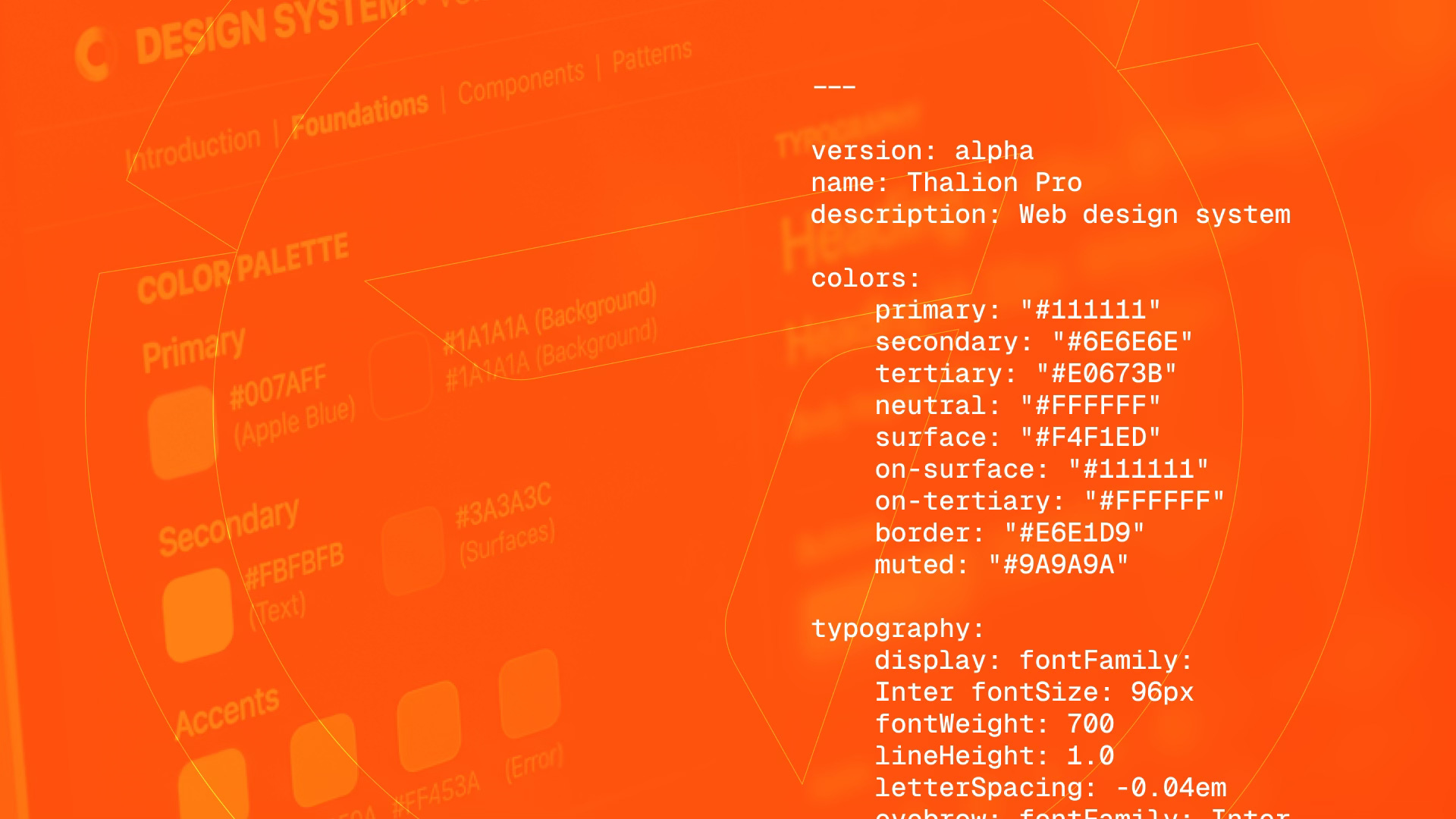
YAML intro. The first part with machine-readable design tokens (colors, typography, spacing, rounded corners, components).
Markdown body. A more human-readable rationale explaining how to apply those values, why they exist, and even how not to use them.
Sections are organized in a specific order:
Overview
Colors
Typography
Layout
Elevation and depth
Shapes
Components
Do’s and don’ts
It is important to mention that as I write this (Q2 2026), DESIGN.md just started. It covers all essential basic information, but it also requires further standard development that would reflect more advanced design system nuances.
Advantages of DESIGN.md
I went through the specification and tested the format with a few tools. This gave me a clearer view, so I can present you the pros and cons this initiative actually has. Let’s start with the positive points:
1. The format attempts to solve a real problem. AI coding agents (Cursor, Claude Code, Copilot, Stitch, etc.) constantly generate inconsistent output across sessions. A stable specification with a persistent, structured source of truth is needed. I believe that Google made a great first move here.
2. The DESIGN.md format is very simple. It’s just widely known Markdown combined with YAML. The document is easy to read not only by a machine but also a human.
3. It’s built on existing standards. Google aligns the new format with the W3C Design Token Format. It also provides a CLI tool to export data into Tailwind/DTCG.
4. Open-source license. Apache 2.0 with a public spec means that DESIGN.md has a chance to become a widely accepted format. All other AI tools can adopt it.
5. Tool-agnostic. The file format itself does not rely on any specific LLM or company. Even without standard implementations, tools like Cursor, Claude, Copilot, or Codex can easily read it.
Weak points of DESIGN.md
Now you know the chances I see for the new format. However, there are also several cons we need to be aware of.
1. One more “standard.” The design-token space already has W3C DTCG, Tailwind, and a few other ways to describe values. Many design systems use their own customized approach for tokens. DESIGN.md adds another layer rather than consolidating.
2. Very early phase. Even on the official GitHub, Google says, “expect changes to the format as it matures.” Early adopters who put effort into building the initial format may need to migrate as DESIGN.md evolves.
3. Limited vocabulary. Components only support 8 properties (backgroundColor, textColor, typography, rounded, padding, size, height, width). In reality, design systems need far more elements to describe, to mention a few: borders, shadows, transitions, gradient stops, animation, and breakpoints. Also, with the current state, there is no way to build dark or light modes, not to mention alternative themes.
4. High risk of oversimplifying design systems. The token-reference scope is limited. Real design systems include motion, accessibility specifications, content guidelines, voice and tone, iconography rules, and illustration styles. I didn’t find any of this in the alpha release of the format.
5. Uncertain if this will become a standard. Despite being open source, DESIGN.md lives under Google Labs and is tightly tied to the Stitch product. No other AI company has mentioned yet that they will adopt the format officially. They may even propose an alternative solution.
6. Output cannot be fully controlled. Even with the best intentions, an agent still reads and interprets the input data. While token formatting is strict, further sections describing the use, do’s, and don’ts may produce different output.
Is DESIGN.md the future of AI-assisted design?
We considered both advantages and disadvantages. Time for a verdict: is DESIGN.md going to be a future standard for agentic design?
One thing is certain: DESIGN.md is a pragmatic and well-defined attempt to give AI a stable design context. Its key strengths are format simplicity, openness, and reliance on the existing W3C work.
While the current alpha version will work for simplified design systems, we need more to cover the full needs of well-defined standards.
What’s more, more sections in the file means more tokens consumed and less context space for actual tasks. The natural expansion of the idea for future purposes could be splitting a single document into a few files. One for core design (an extension of the current DESIGN.md), another for motion, another for accessibility, and so on. What’s more, some elements cannot be simply described; they need to be shown. Iconography and illustrations need visual representation, not just a description.
The direction is good. The potential is there. Now, Google, empowered by the community, should be able to work on the remaining parts of the format, because product builders need a standard that will give them repeatable consistency and quality.
Next steps
If you got interested in DESIGN.md, you should check the project’s official GitHub repository, where you may find the exact specs and examples. Once you do that, you may want to investigate sites with inspiration or the ones that allow you to build your own:
Once you do that, try putting DESIGN.md in Google Stitch and other AI tools and evaluate the results. Did the consistency and quality go up? Let me know!
By the way, if you remember my statement that, in the world of AI, Anthropic focuses on solutions for professionals, here is extra confirmation of this direction: Claude integrates with more tools for creatives.
Behind the scenes…
The internet is full of scammers, and they are also among so-called “influencers.”
I constantly look for examples of well-made sites built with AI, so see how far we may go with new technology.
When I scroll through social media, I notice a lot of “excellent” animated examples, often with bold titles like “AI creates stunning sites.” But, when I drill down into the description of the video, very often I see a statement that the presented example was not made by the author of the post, nor was it generated by AI.
You must pay attention to that so you don’t get trapped in FOMO or focus your attention on people and content that simply try to fool you.
To end with a more positive finding:
If you look for shiny examples of AI-generated websites, the best quality I have found so far is in the examples of the Aura platform built by Meng To. They recently introduced support for DESIGN.md. Make sure to check it out.